
Rosenberg City Directory Holdings
Known Rosenberg and Richmond directory holdings are scattered among the Texas State Library and Archives Commission, UT Austin's Center for American History, and local genealogy resources. The dates matter more than a broad label. UT metadata identifies R.L. Polk & Co. Rosenberg-Richmond issues for 1962, 1968, 1969, 1973, 1974, 1976, 1978, and 1980. TSLAC separately lists Rosenberg-Richmond for 1962, 1982, and 1986. Those entries establish holdings, not a promise that every volume is online or that a name appears in every issue.
| Collection | Years | Where Held | Access |
|---|---|---|---|
| Rosenberg-Richmond city directories | 1962, 1968, 1969, 1973, 1974, 1976, 1978, 1980 | UT Center for American History | Catalog holdings; confirm reproduction or visit options |
| Rosenberg-Richmond city directories | 1962, 1982, 1986 | Texas State Library and Archives Commission | State holdings list; consult its access route |
| Rosenberg telephone directories | 1915, 1918, 1924, 1927, 1930, 1952 | UT Center for American History | Holding metadata; page access must be confirmed |
| Rosenberg/Richmond and West Fort Bend directory | 1985 | UT Center for American History | Southern Directory Company regional volume |
The Texas State Library city-directory holdings are a good first check for the state-listed years. Their catalog entry does not establish a local reverse section, an uninterrupted run, or digital page images. Record the exact edition before drawing a conclusion from any entry. A missing year is often a collection gap, not evidence that a household left Rosenberg.
The Texas State Library city-directory collection shows the state-level path for locating these Rosenberg holdings.
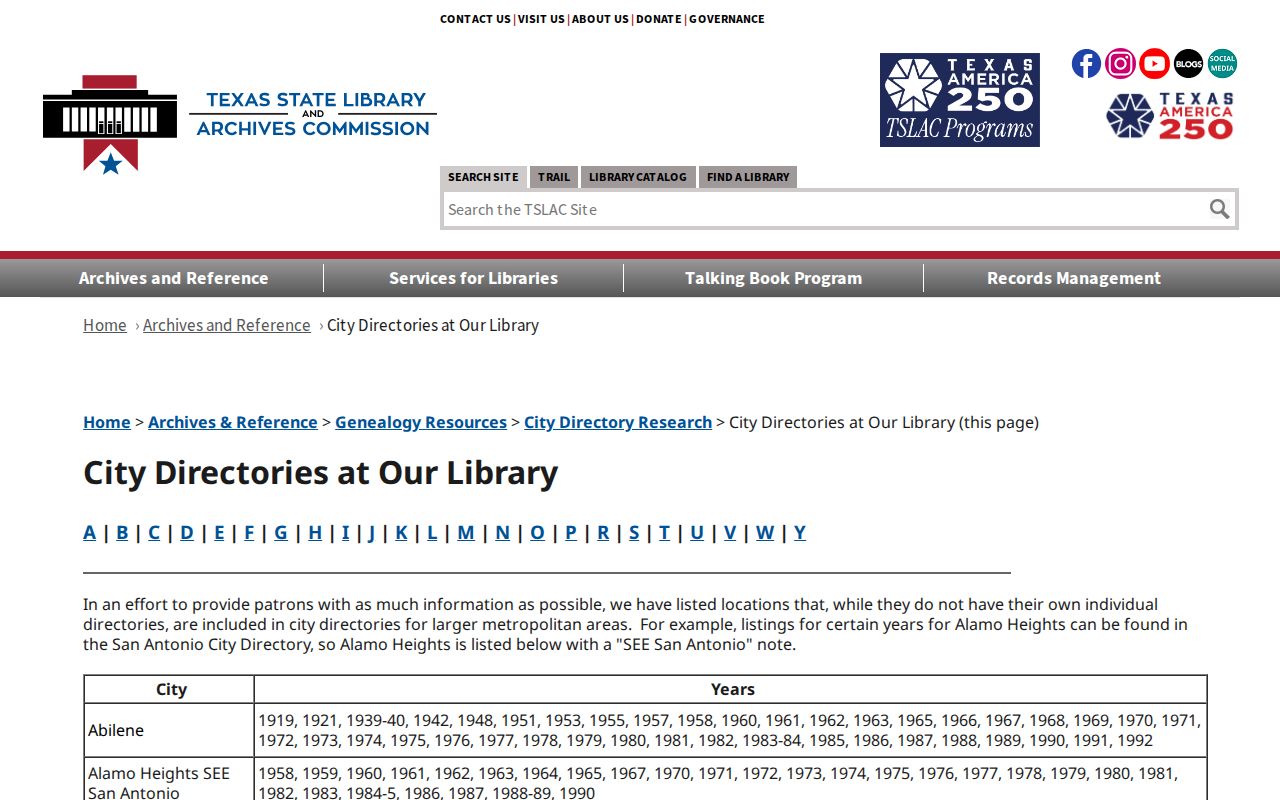
Use the holding list to identify a year first, then ask the named repository about the volume, a scan, or a reproduction request.
Rosenberg Telephone Directory Years
Telephone books are a related subscriber source, not a substitute for a city directory. UT lists Rosenberg telephone directories from May 1915, December 1918, January 1924, April 1927, March 1930, and May 1952. Their publisher history includes Southwestern Telegraph & Telephone Co. and Southwestern Bell. A subscriber entry may offer a name, number or address context, but it does not show every person at a property or settle current occupancy.
The wider January 1985 Southern Directory Company volume covers Rosenberg, Richmond, and West Fort Bend County locations such as Beasley, East Bernard, Fulshear, Needville, Orchard, Simonton, and Valley Lodge. Treat that regional scope carefully. A listing in the book can be a useful connection to the area, but not proof that the subject was inside the Rosenberg city boundary.
UT's Rosenberg-Richmond directory browse supplies the issue and publisher metadata used to separate telephone books from city-directory volumes.
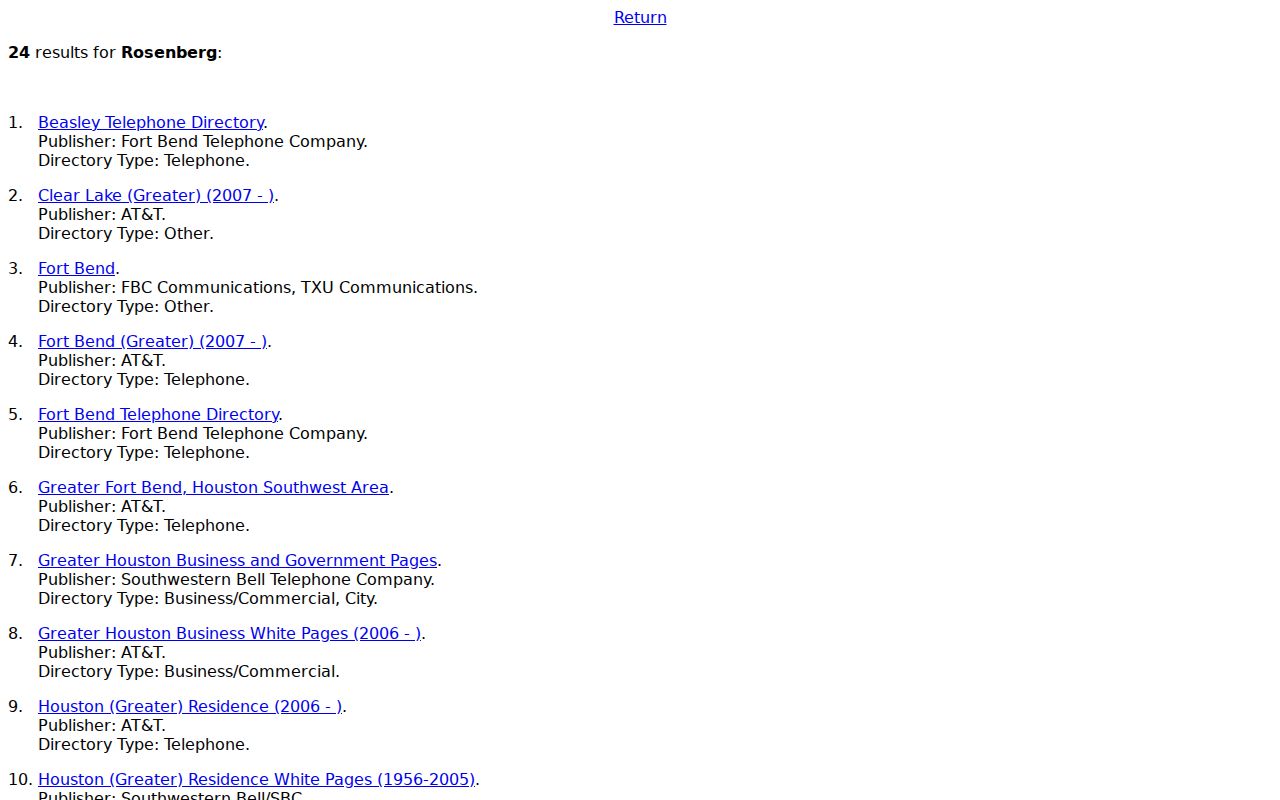
That catalog is a precise way to preserve the month and year of a source before requesting a page or comparing adjacent editions.
Note: A telephone subscriber listing is a dated connection, not a complete household roster or a current address confirmation.
Rosenberg Directory Work at George Memorial
The Fort Bend Libraries genealogy and local-history department at George Memorial Library in Richmond is the practical local fallback when a catalog result needs context. It has staff and volunteer help, microfilm readers and printers, census indexes, cemetery volumes, local newspapers, maps, photographs, vertical files, family histories, naturalization materials, and regional collections. Some subscription databases are in-library only. The library lists microfilm copies at 10 cents per page.
George Memorial's second-floor department is at 1001 Golfview Drive in Richmond. Listed hours are Monday and Thursday 9 to 9, Tuesday and Wednesday 9 to 6, Friday and Saturday 10 to 5, and Sunday 1 to 5. Call 281-341-2608 before making a special trip. Staff can help distinguish a missing scan from an unscanned holding, and can point researchers to a newspaper or microfilm frame when a directory year is absent.
Fort Bend Libraries' genealogy and local-history resources show the collection setting behind many Rosenberg historical searches.
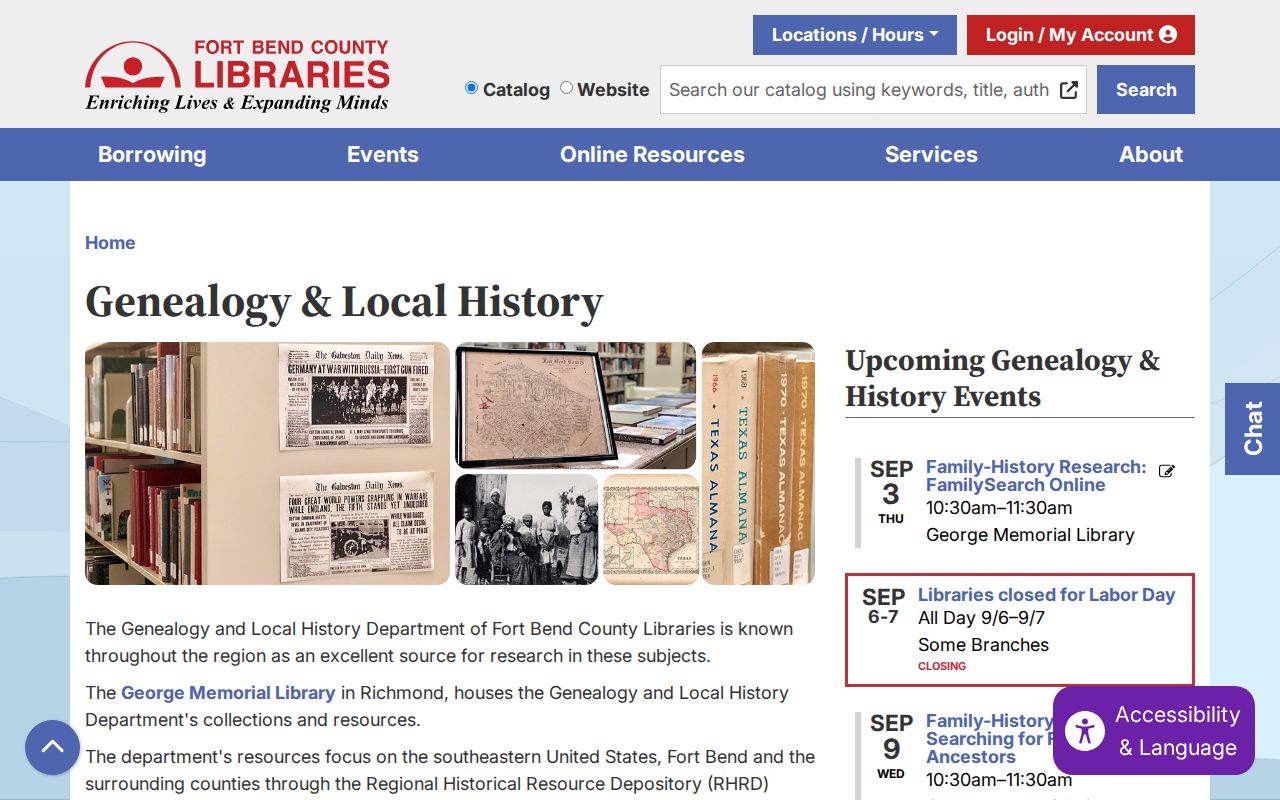
The library route is especially useful when the directory catalog names a volume but does not offer a public page image.
Rosenberg City Directory Entry Fields
There is no official digital Rosenberg sample entry in the research record, so a page should be read as an inventory rather than treated as a fixed modern format. For each located entry, capture what the volume actually prints: its edition and year, page number, name as printed, occupation or category, address exactly as printed, cross-reference, nearby names, and the repository. Keep any telephone number in private research notes if it is necessary. Public examples should mask living people's contact details.
| Edition and page | Identifies the exact volume and lets another researcher find the same entry. |
|---|---|
| Name as printed | Preserves initials, spacing, suffixes, and possible spelling variants. |
| Occupation or category | May help separate two people with the same name when the volume includes it. |
| Address and cross-reference | Records the printed address before comparing it to plats, maps, or a parcel. |
| Neighboring entries | Supplies a dated local context without claiming a shared household. |
- Criss-cross directory
- A street-order section used in some later directory systems. No official Rosenberg reverse-directory run was located in this research.
- Householder index
- An alphabetical index centered on a household name when a volume provides one; check the volume rather than assuming it exists.
- Abbreviation key
- The volume's own explanation of shortened labels. Photograph or transcribe it if the book includes one.
A printed address needs normalization before it is attached to a parcel. Compare street number, unit, city limits, plat or lot/block, and at least one independent source. For a current address chain, use the Rosenberg street directory route rather than stretching a historical listing into a present-day claim.
Note: Preserve the entry exactly as printed before expanding a name or replacing an old address with a modern form.
Rosenberg City Directory Access Gaps
Rosenberg research has a real digitization gap. No official digital Rosenberg directory sample and no official local reverse run were located. That absence calls for a holding request, a library visit, or a direct inquiry to UT or TSLAC. It does not justify describing a catalog listing as full-text access. It also does not mean the books never existed.
The Fort Bend Libraries partner collection at the Portal to Texas History is a smaller digital layer with collection metadata and images. It is not a complete Rosenberg newspaper archive or a substitute for the directory shelf. The library's in-house resources identify additional databases that require a visit.
Rosenberg Library's e-library is a useful comparison point for local digital services, but it should not be labeled a Rosenberg city-directory collection without a confirmed directory scan.
The screen captures a local digital-library route, while the confirmed Rosenberg directory holdings remain catalog and in-person research leads.
Rosenberg Directory Names in Obituaries
When a household disappears between directory years, the Fort Bend obituary database can test a few possibilities without turning a gap into a conclusion. It supports full or partial names, dates, keywords, wildcards, Boolean searching, phrase searching, alphabetical browsing, and cemetery browsing. Its newspaper lineage includes the Rosenberg Herald from 1909 to 1958, Texas Coaster from 1912 to 1958, Herald-Coaster from 1958 to 2007, and Fort Bend Herald from 2007 forward.
Use an obituary as a lead. Capture the displayed name, dates or year, cemetery, notes, source title and date, scan availability, and any O.O.F. notice. O.O.F. means the item is not scanned and needs an in-person department visit. Compare the notice with a cemetery entry, probate material, a directory, or another newspaper before relying on a family relationship or a move date.
The Fort Bend obituary database provides the local newspaper and cemetery search route.
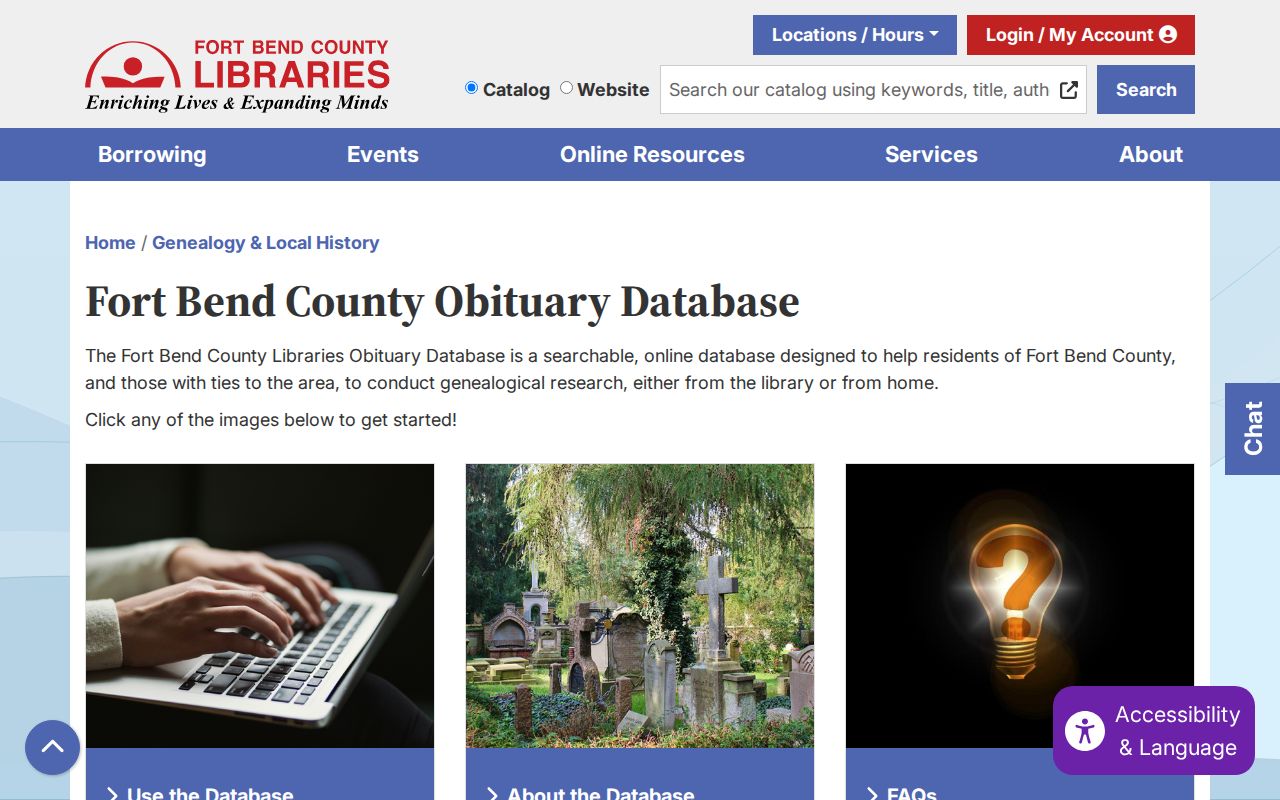
Its search controls make surname variants and dated notices practical companion evidence for a Rosenberg directory entry.
Rosenberg Railroad Directory Clues
Rosenberg's railroad-junction history gives a useful way to separate similar names in older material. City history places the junction in 1880, followed by a post office in 1881 and the New York, Texas and Mexican rail line in 1882. A railroad-era occupation, depot reference, company name, crossing, or nearby Richmond reference can help decide whether a directory result belongs to the same person. It is context, not proof by itself.
The city was platted or founded in 1883, and official city materials disagree on whether incorporation was 1902 or 1903. Keep that difference visible rather than selecting one year without resolving the sources. Early Rosenberg research may be filed under county, railroad, agricultural, or regional terms before a modern municipal address system appears.
Rosenberg's official history provides the local railroad and civic-growth context for interpreting those historical search terms.
Tracing Rosenberg City Directories
A household trail works best when each directory result is treated as one dated observation. Start with the newest available book that fits the question, then move backward through the known issues. Compare the same surname and printed address, but also inspect nearby alphabetic entries and telephone-book listings. If the person vanishes, test a spouse's name, former surname, business listing, road name, or a gap in the collection before deciding that the family moved.
- Record the newest known Rosenberg entry with its edition, page, name spelling, and address.
- Search the next earlier available directory year for the same surname, variant, and address.
- Check telephone-book subscribers, nearby entries, and business categories for dated corroboration.
- Pair the directory year with the relevant census period, newspaper search, obituary, or cemetery record.
- Confirm an ownership or legal-description question through FBCAD and the County Clerk OPR, not through the directory alone.
The sequence uses more than a name match. A directory address can be compared with the 1939 Richmond-Rosenberg property map, a plat, a deed description, or local newspapers when an old road or number is uncertain. The best result states what the dated source says, where it is held, and which independent record supports it.
Rosenberg Directory Research Timeline
Rosenberg directory research moves between separate eras rather than one seamless shelf. The timeline below keeps the directory dates beside the older county sources that can close earlier gaps. Original-record dates and digitization dates are different facts, so a modern online portal should not be used to imply that an old page was created online.
| 1838-1910 | TSLAC lists Fort Bend tax rolls, with early deeds, probate, and court material on microfilm. |
|---|---|
| 1915-1952 | Known Rosenberg telephone-directory issues provide intermittent subscriber context. |
| 1962-1980 | UT lists the known R.L. Polk Rosenberg-Richmond city-directory issues. |
| 1982 and 1986 | TSLAC separately lists Rosenberg-Richmond holdings. |
| 1985 | A Southern Directory Company regional Rosenberg/Richmond and West Fort Bend volume is listed by UT. |
The Fort Bend Historical Commission adds archives, cemetery, and oral-history leads. Oral histories should be cited as interviews with a point of view, not as a neutral name index. The place to verify a named volume remains its holding institution.
The Fort Bend Historical Commission collection is another official route for a documented archive or cemetery lead.
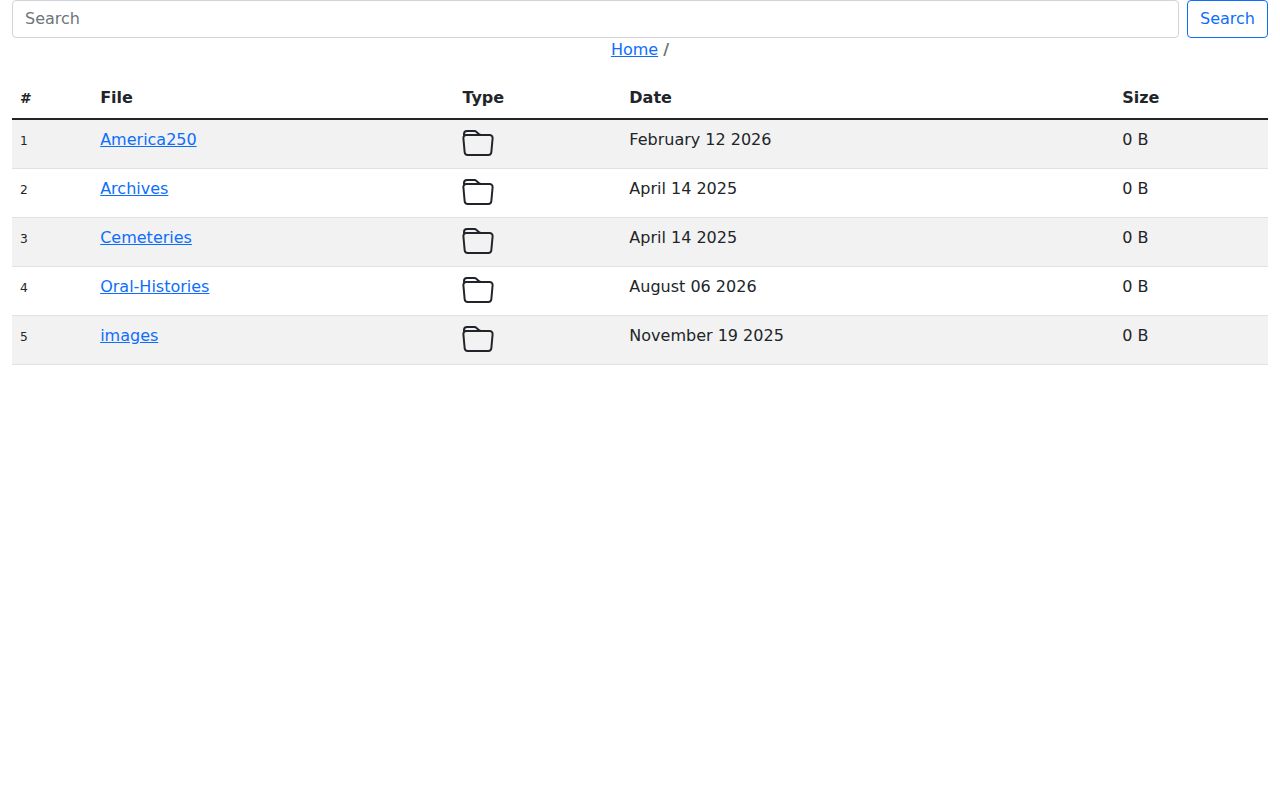
The commission’s collection page complements directory holdings with locally grounded archival context, not a substitute resident index.