
Rosenberg Historical Record Sources
Different sources answer different parts of an address history. The County Clerk index traces recorded instruments. Appraisal and GIS tools identify the modern parcel and legal description. Historic directories, telephone books, newspapers, and census material offer household context. The dates below are coverage statements from the custodians and catalogs, not a guarantee that a particular address or name appears in every source.
| Source | Years it covers | Where held | What it can show |
|---|---|---|---|
| County Clerk Official Public Records | 1821-present online library; historic images vary | Fort Bend County Clerk | Recorded deeds, easements, liens, DBAs, and legal-description trails |
| Fort Bend microfilm | Deeds 1838-1886; tax rolls 1838-1910; probate 1838-1877 | TSLAC guide and local-history holdings | Early land, tax, probate, and court leads |
| Rosenberg-Richmond directories | Known telephone years 1915-1952; city-directory years 1962-1986 as cataloged | UT, TSLAC, and library routes | Printed subscribers, households, addresses, and context, subject to gaps |
| Fort Bend obituary database | Mid-1800s-current | Fort Bend County Libraries | Names, dates, cemetery, newspaper source, scan or O.O.F. status |
| Richmond Rosenberg Property Map | 1939 | Rosenberg Map Library | Historic lot, road, downtown, and place context |
For a nineteenth-century question, start with tax rolls, deeds, probate, naturalization, and newspapers. A 1900 to 1950 trail can add telephone books, city maps, cemetery records, and local notices. For later decades, directories, obituaries, deeds, and current parcel tools can be combined, with greater care around freshness and protected information.
The Texas State Library and Archives Fort Bend guide lists the reel-level microfilm routes behind early property research.
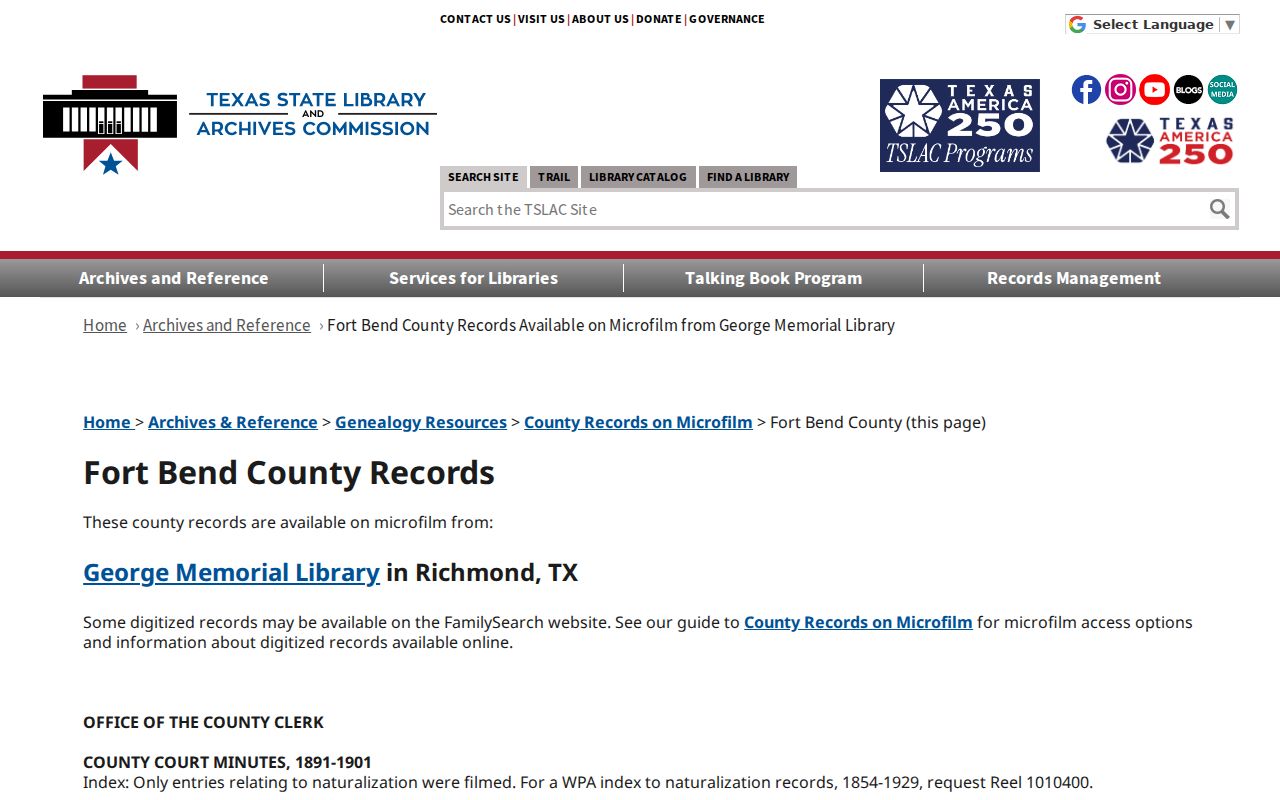
The guide is especially important when a previous-residents search reaches before a convenient online image or when an early deed volume needs a cited reel reference.
Rosenberg Parcel Records First
Begin at the present address without assuming it has always used the same street number. The Fort Bend Central Appraisal District search has By Owner, By Address, By ID, and Advanced routes. Its observed advanced fields include owner name, street number, street name, Quick Ref ID, Geographic ID, subdivision, neighborhood, tax year, and property type. Save the legal description, Quick Ref ID, Geographic ID, situs address, owner display, owner mailing field, subdivision, and taxing units as separate notes.
That separation matters. FBCAD’s owner mailing field is a tax-mailing clue, not a statement that the listed person occupies the property. The situs field identifies the property’s location. County and City GIS can then add parcel, subdivision, MUD, floodplain, road, city-limit, ETJ, plat, and annexation context. Compare those layers to the deed rather than treating a map or appraisal card as a title opinion.
The Galveston Historical Foundation house and property guide is a method model for organizing parcel, deed, map, and directory evidence.
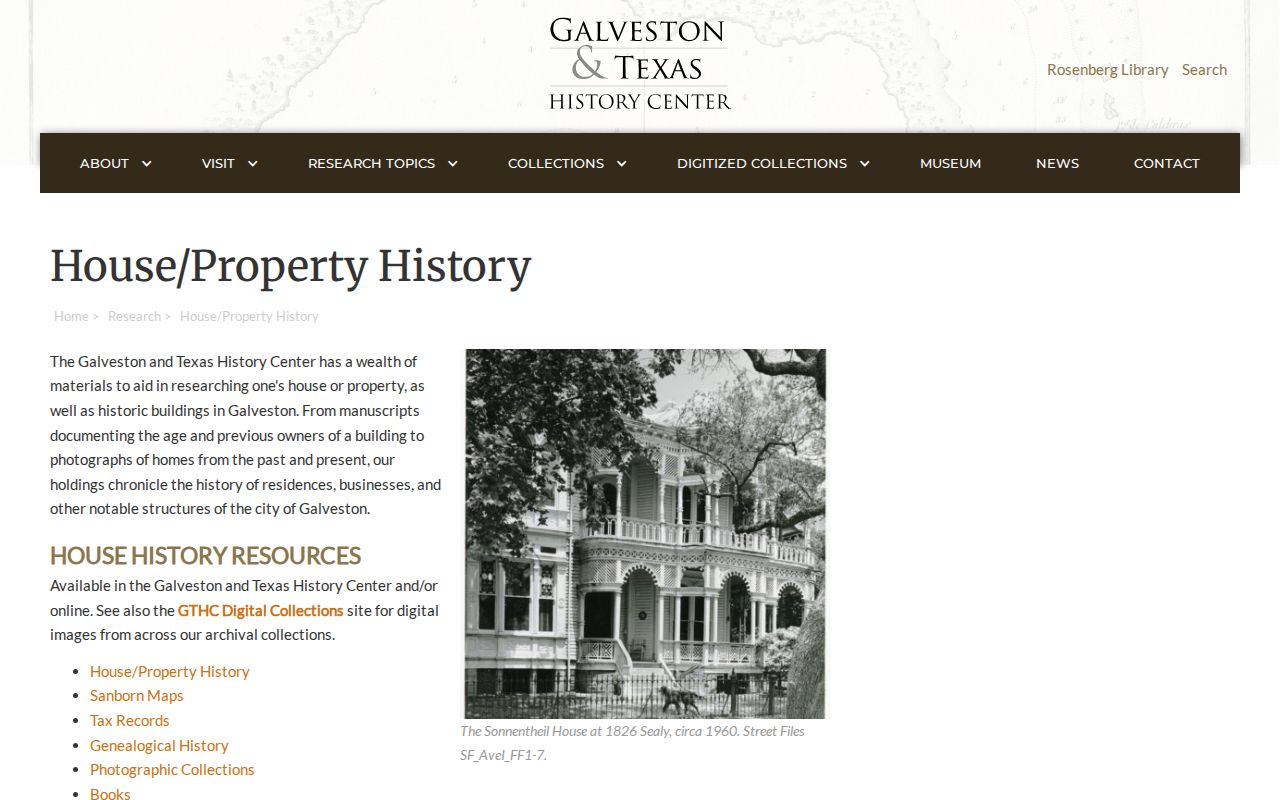
This is a Galveston method model, not a Rosenberg collection guide. Research did not locate an equivalent Rosenberg-specific house-history guide, so local work should use Fort Bend custodians and holdings instead.
Rosenberg Deed Records Backward
The Fort Bend County Clerk describes its Official Public Records library as holding millions of documents from 1821 forward. Its FAQ identifies party name, grantor, grantee, filing date, instrument number, and document type as search routes. A recorded instrument can establish a transfer or other event, but it should never be converted into an automatic claim that the named party lived at the property. The legal description is the durable bridge when street labels or numbers change.
- Use FBCAD and GIS to confirm the parcel, legal description, and current owner display. Keep the owner-mailing and situs fields apart.
- Search the current owner in the Clerk’s index as grantee and locate the purchase instrument by date, instrument number, and legal-description text.
- Record the seller, then search that seller in the grantee role to find the earlier acquisition. Search both roles because each records a different side of a transfer.
- Repeat the comparison backward, carrying the lot, block, subdivision, abstract, or survey language with the address. Flag instruments that transfer multiple lots.
- When the online image is unavailable or the date falls in early material, use the Clerk’s instructions, copy route, or the TSLAC microfilm guide. Record a missing page or duplicate-volume warning rather than filling the gap by inference.
Fort Bend County Clerk Recording is the official custodian route for recorded instruments and copy guidance.
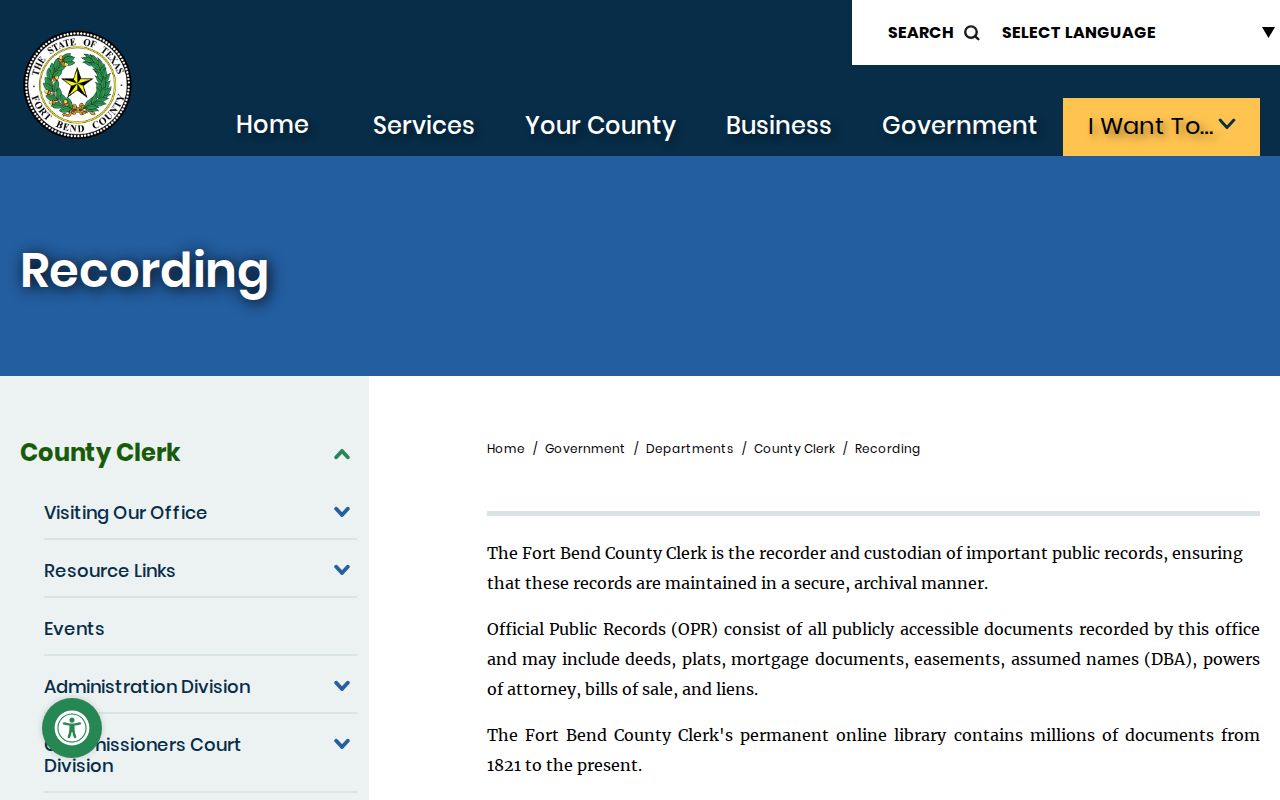
The Clerk portal was observed behind a browser-test or session-cookie gate, so exact live controls, pagination, and image behavior should not be assumed. The official instructions and direct request route remain the reproducible fallback.
- Grantor
- The party conveying or transferring an interest in a recorded instrument.
- Grantee
- The party receiving an interest in that instrument. In a backward search, the earlier seller may appear as grantee on an older acquisition.
- Chain of title
- The sequence of recorded transfers and related instruments for a property interest. It is not the same as a list of occupants.
- Legal description
- The lot, block, subdivision, abstract, survey, or similar land description used in recorded documents. It often survives address changes better than a street number.
Rosenberg Records Before Digital Access
Early Fort Bend research moves from portal search to microfilm and archive holdings. TSLAC lists deed records from 1838 to 1886, deed-of-trust records from 1871 to 1887, an index spanning 1837 to 1897, probate from 1838 to 1877, and tax rolls from 1838 to 1910. These are strong leads for prior ownership and place history, especially before a modern street address was stable. They do not constitute a continuous occupancy register.
The guide flags missing deed pages in volume D and a duplicate or transcription issue in volume F. A transparent previous-residents note should preserve those record gaps. The County Clerk’s broad 1821-present library history does not mean every historic page is viewable online, because sensitive legacy images can be indexed but withheld from public display. Ask for a defined volume, page, party, instrument, or date range rather than an undefined “resident file.”
Note: A portal migration or image import date is different from the date of the original deed, tax roll, probate paper, or map.
Rosenberg 1939 Map Records
The Rosenberg Map Library includes a Richmond Rosenberg Property Map dated 1939. It can connect an old property question to lot or block, downtown, road, and ownership research. It cannot prove title or identify all people who lived at a place. Pair it with the legal description, a directory year, a deed, and local newspaper material before attaching a household to the map.
Rosenberg’s local history supplies useful context for unstable addresses. City materials describe an 1880 railroad junction, the “Mudtown” nickname associated with dirt streets and Brazos flooding, and early town growth around rail and agriculture. A railroad-related business or occupation may help distinguish a common name in a printed directory. Floodplain, drainage, crossings, depots, annexation maps, and county deed descriptions can likewise explain why a historic location reads differently today.
Rosenberg’s history page provides the railroad and local-growth context for interpreting old location references.
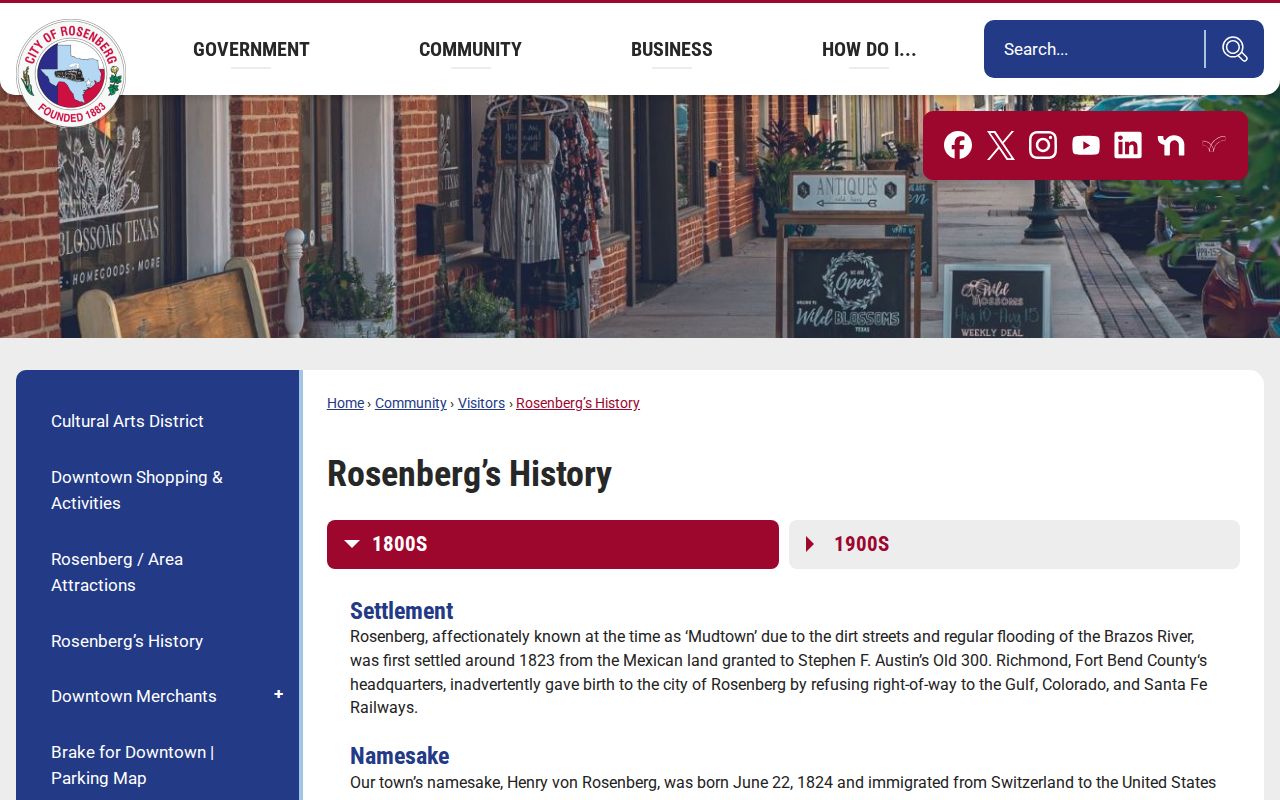
The history is a disambiguation aid, not a substitute for a deed or directory entry. City materials also disagree on whether incorporation was 1902 or 1903, so both cited years should remain open until a primary record resolves the difference.
Rosenberg Directory and Census Records
Deeds show the property trail. Historic directories help ask who lived here before, but their runs are intermittent and their inclusion rules vary. UT’s catalog identifies Rosenberg telephone directories for 1915, 1918, 1924, 1927, 1930, and 1952. Its R.L. Polk Rosenberg-Richmond city-directory holdings include 1962, 1968, 1969, 1973, 1974, 1976, 1978, and 1980. TSLAC separately lists Rosenberg-Richmond for 1962, 1982, and 1986, and a Southern Directory Company volume covers the wider West Fort Bend area in 1985.
Start at the newest available edition near the address date, then work back. Compare the printed name and address exactly as shown, check the same surname and nearby entries, and retain the edition, page, and holding. A directory has no automatic reverse section. Research did not locate an official reverse-directory run or a digital Rosenberg sample entry, so do not assume an address can be searched in every book. The collections themselves are detailed in the Rosenberg Directory Book.
- Choose a directory or telephone book closest to the target period and record its publication month, year, page, and address form.
- Compare the same name and address in the next earlier available edition. Test a spouse, former surname, business listing, or road variant only when another source supports it.
- Pair the directory period with the appropriate federal census schedule and use age, household composition, or place context as a second anchor rather than treating one name as conclusive.
- Check the parcel legal description, a deed transfer, obituary, cemetery, or newspaper notice. Keep a directory listing distinct from a current-residence claim.
George Memorial Library’s genealogy department has census indexes, newspapers, maps, burial records, local histories, and in-library databases. Microfilm reader and printer copies are listed at ten cents per page. Some subscription databases require an in-person visit.
Note: Directory catalog metadata identifies a holding, not a remote image, so confirm reproduction or in-person access before relying on a cited year.
Rosenberg Newspaper Record Context
The Fort Bend obituary database is a strong endpoint and corroboration source for past residents. It supports full or partial names, birth or death dates, keywords, wildcard and Boolean searching, phrase search, alphabetical browsing, and cemetery browsing. Its newspaper lineage includes Rosenberg Herald from 1909 to 1958, Texas Coaster from 1912 to 1958, Herald-Coaster from 1958 to 2007, and Fort Bend Herald from 2007 forward. An obituary is an authored notice, so compare it to a directory, probate record, cemetery record, or another newspaper source.
An O.O.F. notation means the relevant material is not scanned and calls for a George Memorial visit or targeted library request. The Portal to Texas History Fort Bend Libraries collection adds a smaller digital layer with 291 items across ten decades and two languages at the time of inspection. It is a partner collection, not a complete Rosenberg newspaper archive.
The Portal to Texas History collection provides the digitized Fort Bend Libraries entry point.
When the portal has no match, move to the library’s microfilm, subscription resources, or a defined request rather than concluding that a previous resident left no local trace.
Fort Bend Libraries local-history resources describe the area’s historical collection and library context.
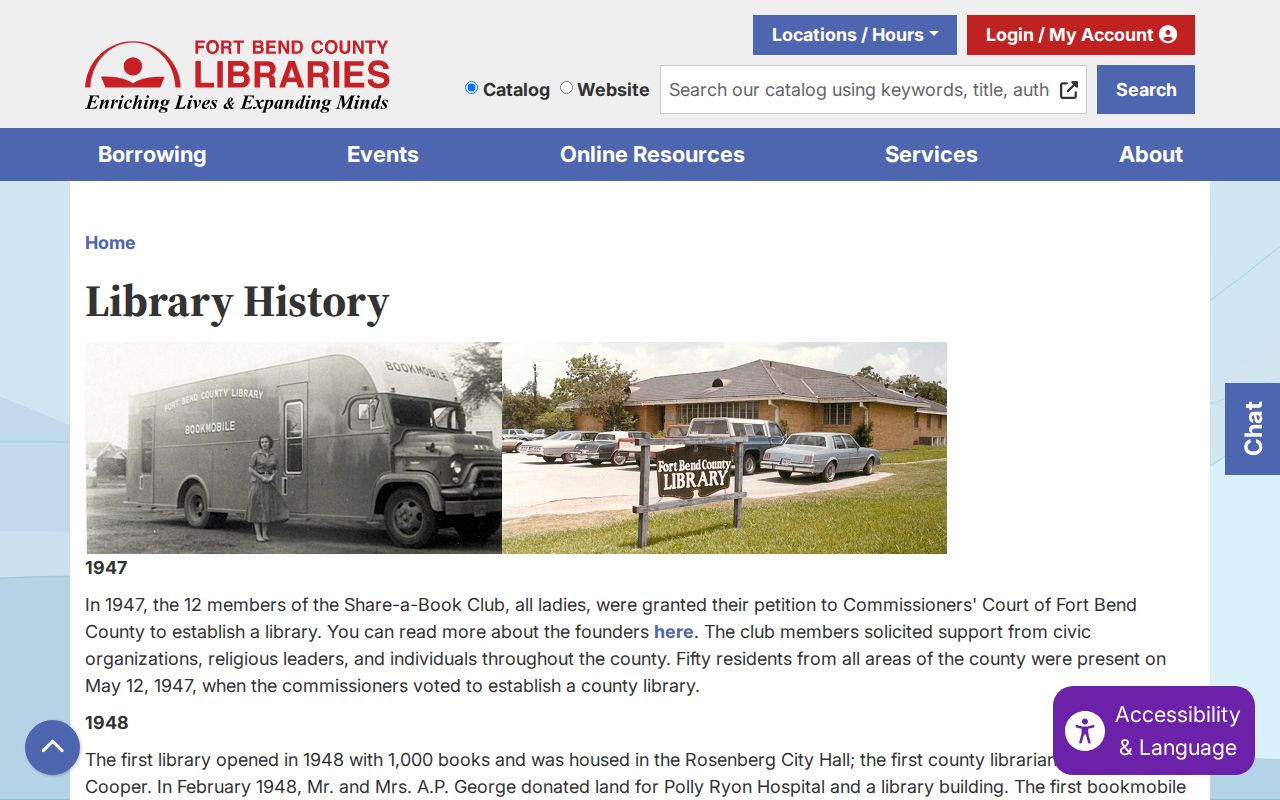
George Memorial’s local holdings can supply the physical newspaper, vertical-file, photograph, cemetery, or microfilm follow-up that a catalog record alone cannot provide.
Rosenberg Address-Record Gaps
Several gaps should remain visible in an address history. No official local street-by-street resident roster, complete HOA directory, public permit-result search, city-run cemetery index, local Sanborn scan, or digital Rosenberg directory sample was located. The City moved permit and plan activity to MGO on June 25, 2025, but historical permits may be in earlier City systems or require a public-information request. A permit application is not proof of issuance or completion.
There is also no complete official Rosenberg renumbering or renaming chronology in the researched material. Bridge old and current forms with road names, lot or block, subdivision, legal description, plat, map landmark, and directory year. When County Clerk portal behavior is blocked, retain the official URL and use the instructions or custodian contact. A no-result may reflect spelling, jurisdiction, access, coverage, or retention rather than an empty history.
Note: Keep an unsuccessful portal search as an access note with its date, visible fields, and custodian alternative instead of treating it as proof.
Lawful Rosenberg Record Research
Previous-residents research belongs to house history, family history, estate or heir work, and careful local research. Use two independent anchors before joining a person to an address, such as a printed directory entry plus a parcel or recorded instrument. Do not publish full dates of birth, protected addresses, driver-license information, voter identifiers, private phone numbers, or sensitive court and victim details. A record can be public yet still be unsafe to aggregate.
Texas public-record rules are record-specific. The Texas Public Information Act is a path to defined records held by a government body, subject to confidentiality and redaction rules. If a file contains protected information, stop at the field description and contact the official custodian about an appropriate request or access limit.